The past couple
days have been relatively lazy-- Chris and Sean have both been feeling
sick and we've all been taking it easy as a result. Sean's had a bad
cough and cold since we got here and has been pretty low energy but is doing okay.
Chris, on the other hand, came down with what appears to have been
malaria on Sunday morning, and has spent the better part of the past 48 hours sleepless and vomiting- no fun. After perking up a bit and spending Sunday
out at the falls and having tea, the evening brought back with it the
nausea and fever (it's worse at night--a tell tale sign of malaria). He spent most of
the next day in bed, consulting with the Peace Corps doctor
back in Lusaka, and contemplating getting a ride home. Having taken
several rounds of the malaria medicine he carries with him, he woke
up this morning feeling about a thousand percent better-- much to all of our
relief-- and decided to stick out the rest of his recovery here in Livingstone. The evening tonight brought back some of the nasty symptoms, but he's been quite a trooper and should hopefully be fully recovered soon. Doubling up on the DEET and employing our mosquito nets and
doxycycline (daily anti-malarial drugs) religiously!
Tuesday, January 1, 2013

Wild Life
We arrived in
Livingstone a few days ago and have been having quite an authentic
African experience so far. In so many ways, Zambia is exactly what we
expected, and in so many ways, it's not. We've seen wildlife and been
bit by mosquitos, chatted with locals and sampled the cuisine, yet
our hostel here is nicer than any we stayed at in Europe.
On our first day we
visited Victoria Falls- the largest waterfall in the world. We didn't wear any rain gear, instead getting soaked
by the warm spray as it was forced up the canyon walls by the massive
quantities of water coming down off the falls. Standing in awe of the
majestic wall of water, we did our best to do as Norman had told us,
and “feel the falls with our hearts.” Both its size and beauty
could captivate for hours, and have brought many visitors back again
and again. There's no doubt in my mind that it deserves to be honored
among the top ranked natural wonders of the world.


After taking in the
view from various points along the path, Chris lead us down a steep
path towards “the Boiling Pot”- an area just below the falls
where you can gaze up at the canyon walls and watch bungee jumpers as
they plummet off a bridge that connects the Zambian side to the
Zimbabwe side. Before we began our descent, Chris advised us to grab
some large sticks in order to fend off any attacking baboons. The
park is full of them and they've become entirely too comfortable
around humans, often getting aggressive as they attempt to steel
anything that looks like food. He nonchalantly picked up his weapon
and we all followed suit, somewhat nervously following him down the
trail.

About a quarter of
the way down, there they were--a gang of about 8 or 9 baboons and
their babies camped out in the middle of the trail. They didn't
flinch a bit as we approached, nor as we attempted to scare them off.
It took a fair amount of convincing, but eventually, they decided to
move along.


We continued
following the path which lead us down through the tropical forest and
across a stream. When we arrived at the bottom, we perched ourselves
on some rocks and Kelsey and I dipped in the water a bit to cool off.
As the clouds started rolling in, we decided to call it a day and
head nearby to The Royal Livingstone Hotel for “high tea”- a
luxurious indulgence popular with Peace Corps volunteers fresh from
the villages.


We sat the entire
afternoon, thoroughly enjoying pot after pot of tea and gorging
ourselves on fantastic pastries and cakes. When tea time finally ended we made
our way down to the riverfront bar to take in the view of the Zambezi
river.

When we'd had our fill of that we caught a taxi and headed back toward
town. On our way out of the rather massive hotel grounds in the cab, we happened
upon a Zebra munching on some grass on the side of the road.
Apparently, the hotel has a variety of animals that wander through
it's grounds. The Zebra spooked a bit as we went by, and began
running along the road a few meters in front of the cab for a ways
before ducking into the trees and out of sight. Literally seconds later we
passed by a giraffe who was also snacking on the grass no more than ten
feet from the road. 'Surprised' doesn't even begin to describe...
Unfortunately it all happened so suddenly and was over so quickly,
there was no time for pictures, but we're committed to squeezing in
some real safari time at some point while we're here!
African Adventures
Since we arrived in Lusaka, our time
has been jam-packed with new experiences-- a non-stop procession of
kind people, wonderful moments and astounding sights. After a mere
three days of being in Zambia, I feel as though I couldn't possibly
remember (let along recount) all of the fantastic things that have
happened, or all of the big-hearted people we've met. I'm absolutely
blown away by this place and it's beauty.


For those of you who, like us, know
next to nothing about Zambia (but would like to know more), here's a
quick overview: The Republic of Zambia gained it's independence from
England in 1964 and has a
relatively stable (yet still somewhat corrupt) democratic government.
It is located in the south/central part of the continent of Africa and is bordered by the Congo and Tanzania to the north,
Malawi and Mozambique to the east, Zimbabwe, Namibia, and a tiny bit
of Botswana to the south, and Angola to the west. We've arrived at
the beginning of the rainy season, which usually lasts from November
through April but this year has started a little bit late. During
these months, the country is incredibly lush and green, and many
things grow easily here (including the grass which can make viewing
animals more difficult). During the dry season, we are told,
everything is brown, the grass is shorter and it gets a bit hotter.
Otherwise, the temperature remains pretty consistent throughout the
year-hot during the day, and still pretty hot at night.

Our first two nights were spent at a
wonderfully rustic hostel in Lusaka. It was located pretty close to
downtown, although you'd never know it. Judging by it's surroundings,
you might assume you were on the far outskirts of some forgotten city
in the middle of nowhere. The one lane dirt roads in the surrounding
neighborhood were filled with pot holes, lined with trees, and dotted
with mounds of garbage left to rot. As far as we could tell during
the short walk we took, there wasn't much at all in the immediate
vicinity to see or do. Fortunately, the hostel itself was a great
place to be. It had it's own friendly staff, an outdoor grass-roofed
patio/bar and staffed kitchen serving meals throughout the day.


On our first full day, we caught a cab
out front of the hostel and ventured to the bus station to try and
get our tickets to Livingstone. We made fast friends with our cab
driver on the way there. His name was James and he shared with us
many of his insights and opinions about the political system, the
educational system, and the job prospects for people in Zambia.
Mostly, I think, he was glad to have someone in the back seat who
cared, and it seemed that he would continue talking for as
long as we continued listening (or until we got to the station). He
had gone to school only up until primary, which is quite normal here,
and had started working when he was 7 or 8 to help his family get by.
He was perhaps in his mid 60's and had been driving a taxi for 14
years. In addition to driving his taxi, he ran a funeral home. He
told us about an article that an American reporter had written about
him a few years back, and explained how he often talks on the radio
about his life, hoping to inspire other Zambians to find a niche and
start their own businesses.
When we arrived, James graciously
offered to show us the way to the ticket booth (and then, of course,
provide our transportation back). He waited patiently a few yards
away while we pushed our way through what was perhaps the rankest
smelling crowd of people I have ever encountered, to get to the
ticket booth. With New Year's approaching, lots of people were making
plans to travel out of town and the buses were almost completely sold
out. We had been advised by multiple people to pay the (negligible)
extra to spring for the “luxury” buses (which have a/c) rather
than endure the “ordinary” buses (which are more crowded and do
not have a/c) but
unfortunately, all of the luxury buses were booked. We managed to get
two seats together on a regular bus and hoped for the best (or at
least not the worst).
We got back in the
cab and enjoyed another nice chat with James on our way to the local
mall to run some errands. When we arrived there, he gave us his
personal phone number and the website for the article he and his
business had been featured in. We promised to look him up and wished
him the best, thanking him for sharing his story with us.
After returning
from the mall, we hung around the hostel patio for the afternoon
enjoying some gin & tonics (we've read they're supposed to help
keep the mosquitos away, so I'm goin' with that) and attempting to
stay on top of our journaling. At one point we noticed James sitting
at the bar. We had learned that out front of the hostel was “his
spot” and he liked to hang out there whenever he didn't have a
fare. Apparently he took his breaks there, too. We got up the nerve
to ask him for the picture we were wishing we had gotten earlier and
he obliged.

Friday night there
was live music at our hostel and we met a whole slew of great people
throughout the evening. Tilly was on business from Ethiopia and after
talking to him for less than five minutes, he insisted we come and
visit him there. Norman was a local Lusakan and thrilled to tell us
all about Livingstone and Victoria Falls (our next stop). Rupert and
Jason were in the band and couldn't have been more excited to learn
that Sean had brought his saxophone. They welcomed him
enthusiastically onto the makeshift stage with them, and his “rare”
instrument quickly made him the star of the show.
(video coming soon!)
We had
a great time meeting and chatting with everyone and couldn't believe
how open and friendly all the locals were, or how many of them hung
out at the hostel. We learned that the band, 'Kapiri Mposhi Top Rank
Sweet' as they call themselves, are not merely the only classic rock
cover band in Lusaka, but are the only band of their kind in all
of Zambia.
The following
morning, James was waiting in his usual spot and was happy to drive
us back to the station to catch our bus. We said goodbye and headed
through the small gap in the fence and into the “station”, which
was really just a big dirt area inside a fence with little ticket
stands all around. It was absolutely swarming with people, and we
were an overly-cautious hour early for our bus. With nothing else to
do, we plopped our bags down near the ticket booth where passengers
seemed to be waiting and people watched. It was so different and
interesting, we couldn't have pealed our eyes away had we wanted to.
Despite all the people moving around and the constantly approaching
vendors trying to sell us various things, we never felt as though it
was a dangerous area. We simply sat and watched.

As our departure
time approached, we stood up from our backpack-seats, stretching and
preparing our legs for the long, cramped 7 hour journey ahead. Just
then, who should walk up but Chris, Sean's friend in the Peace Corps
who we were supposed to meet in Livingstone. Behind him was Kelsey,
Chris' good friend who's also visiting while we're here. They had
been up north in some of the villages and had happened to reserve
seats on the same bus. As we boarded, we happened to glance back to so James waving goodbye to us from in front of the bus- our first Zambian friend!
The bus ride wasn't
half as bad as we had prepared ourselves for. It took us through some
amazing country on our way south, and we spent the afternoon
alternating between napping and gazing out the window. The Zambian
countryside is vast, green, and largely untouched. We passed through
town after tiny town, slowly making our way south and admiring the
grass-roofed huts and perfectly planted fields.


The bus stopped
quite a few times along the way. In many of the small towns, people
would approach the bus holding bowls or baskets full of food up to
the open windows and trying to make a sale. Occasionally one of the
passengers would exchange a few Kwatcha for an ear of corn or a piece
of fresh fruit. It all seemed like it could be straight out of
National Geographic.

All in all, we've
been amazed so far by the friendliness and sincerity of the Zambian
people. Everywhere we go, we are greeted with broad smiles and warm
words of welcome. We get the feeling that they genuinely want us to
enjoy our time in Zambia, and so far, that's exactly how we feel.
Wednesday, December 26, 2012
Farewell Europe
As we prepare for our flight to Zambia this afternoon, we find ourselves reflecting on the past four months (has it really only been that long?! It feels like much, much longer) and everything we've done up to this point. We've seen incredible places, met countless wonderful people, experienced and learned so much. Looking back on it now, it's hard to believe that our European adventure actually happened, that we won't wake up in our own bed tomorrow and realize it was all just a dream.
When we started this trip back in September we had a vague idea of what we might gain from traveling. Now we realize we didn't have a clue what was really in store for us- as Americans, as information addicts, as a couple, as human beings. It's obvious that the effect of this trip on our lives has already been profound, and we realize now more than ever, that we're only just getting started.
We want to take a moment here to acknowledge, and to offer our most sincere appreciation to everyone who--up to this point--has played a role in making this incredible experience possible for us:
Mark and Lucy in London
Victoria in Sheffield
Liz, Greg, and Frankie in Liverpool
Mateo and his friendly flatmates in Granada
Roberto and Geraldine in Marbella
Luis, Manuel, and Pablo in Sevilla
All the staff and guests at the Garden Backpacker in Sevilla
Emmanuel and his friends in Marseille (and Daryl, too!)
Jerome and the rest of the amazing couchsurfing community in Aix
The staff and guests at our hostel in Roma (especially Melissa, Chelsea, and Stephanie from Canada, and Anna and JP from Mexico)
My lovely Mamma in Florence
Becca and Kaitlyn in Florence (and Rome, and Venice...)
Maggie, Alex, Dimitra, Sylvia, Moe, Stephanie and the rest of the gang in Esbjerg
Lars in Copenhagen
Theo in Amsterdam
Claudia, Inge, Martin, and Matthias in Dreieich
Thank you all for opening your homes to us, for sharing conversation, for the meals, the drinks, the laughs- it wouldn't have been the same adventure without you, and we are so, SO grateful!
And a very special-extra-big THANK YOU to our wonderful families back home who continue to support us in more ways than we can count.
And a very special-extra-big THANK YOU to our wonderful families back home who continue to support us in more ways than we can count.
And now, Chapter 2...
Sunday, December 23, 2012
Yuletide Treats and Traditions
One afternoon, when we were in Copenhagen, we went to the store to pick up some groceries and drinks for an evening meal at our host's house. We walked the isles, as usual, trying to determine what everything was and find the things we needed (or appropriate substitues for them). Once we'd found all of our dinner ingredients, we wandered over to the beer isle. In Denmark in general things are quite expensive, so as usual, we were hunting for the best deal. We agreed on a 6 pack of what looked to us like a seasonal holiday beer--perhaps it was a porter or a stout but we couldn't tell for sure as neither of us reads Danish. Its appearance reminded us of something that might come out of a microbrewery back home around this time of year. In any case, it cost about half as much as anything else on the shelf- a great bargain!

 In Chile, Viejo Pascuero (Old Man Christmas) is greeted with a traditional Chilean "pan de pascua", a sponge cake flavored with ginger and honey and full of candied fruit. In Kenya, a child might save Santa a bit of roasted goat, which is the traditional Kenyan Christmas dinner. If you live in Argentina, Santa might stop for a break in your kitchen and have some "sidra"-- an alcoholic apple cider which is used for toasting on Christmas Eve.


When we returned to the apartment, we began making dinner. As we often do while cooking, we each cracked open a bottle. It was like sipping on a soda, mixed with several tablespoons of honey and artificial "Christmas flavor." If you could manage to discern even the slightest taste of beer, you'd be lucky. What was this awful stuff?!
When we examined the bottles closer (something that, in retrospect, we probably should have done before we bought them) we realized that this "beer" contained almost no alcohol- a mere 1.7%. Okay, so we'd accidentally bought the Danish equivalent of "O'Doul's", but why on earth was it so sweet and syrupy?? Who could possibly want to drink this stuff?
When our host, Lars, returned home from work, he noticed our open beers, chuckled a bit, and asked what we thought of them. When we told him how terrible they were, and that we'd only gotten them because they were cheap, he offered an explanation. "These beers are for Santa", he said. You see, Danish parents tell their children that this particular beer is the one that Santa likes, and so children all over Denmark leave it out for him on Christmas Eve, along with a bowl of risengrød (rice pudding). Of course, kids want to taste the special Santa beer, which is why it's sweet and non-alcoholic.
 |
| Hanging at the Christmas market in Dreieich |
We got a pretty big kick out of this. It had never crossed our minds that Santa might prefer something other than our traditional milk and cookies. This prompted me to do a little research and find out what people in other places around the world tell their children that Santa likes. As it turns out, Santa only prefers milk and cookies when he's visiting the U.S. and Canada.
I learned that in Germany, children leave letters, not cookies, for Santa (or rather the German equivilent, "Christkind"-- a white-robed, present-bearing figure). In France, instead of leaving cookies for Père Noël, children fill their shoes with carrots for his donkey, Gui. Dutch children, too, leave out carrots, hay and a bowl of water for Sinterklaas' horse.
 |
| Sean helping to set up the nativity scene. |
The Australians and Brits figure Santa needs something a bit hardier than milk and cookies to sustain him through his long night, so the children there leave out sherry and mince pies. Also, British children, instead of mailing their Christmas lists, throw them in the fire and "Father Christmas" reads the smoke to learn what they are wishing for. In Ireland, Santa can expect more mince pies, but there he'll get to wash them down with (but of course!) a nice tall glass of Guinness. In Sweden, Santa can look forward to a hot cup of coffee.
 In Chile, Viejo Pascuero (Old Man Christmas) is greeted with a traditional Chilean "pan de pascua", a sponge cake flavored with ginger and honey and full of candied fruit. In Kenya, a child might save Santa a bit of roasted goat, which is the traditional Kenyan Christmas dinner. If you live in Argentina, Santa might stop for a break in your kitchen and have some "sidra"-- an alcoholic apple cider which is used for toasting on Christmas Eve.
The Biens have their own traditions, too. Like many Germans, throughout the month of December, they progressively light 4 advent candles, adding a new one on each Sunday leading up to Christmas. Once the 4th candle is lit, that's when they can put up their tree--rather late in the month by our US standards. On Saturday (okay, one day early wont hurt anybody) we helped to trim the tree and set out the manger.


Every Christmas for many years, Inge has made these special little angels. Each is a one-of-a-kind, hand-sewn labor of love, taking someone with practice around 3 hours to make! They use them to decorate their tree, and very rarely as gifts (because, well, after 3 hours of cutting, sewing, and shaping you've become quite attached to the little things). My family was lucky enough to receive one of these special decorations in the mail the year that Claudia lived with us, and it has hung on our tree every year since. This Christmas, I was lucky enough to get a lesson on how they're made.
 |
| Claudia, Inge and I working on our angels (Sean decided to pass- crafts aren't really his thing) |
 |
| Three or so long hours later, my finished angel :) |
I find it fascinating that traditions surrounding Christmas are so varied in different places... that people who believe essentially the same thing, and celebrate the same holiday, have invented so many different stories about it, have so many different ways of celebrating it.
Although it's difficult to be away from our families during the holidays, and we can't help but miss our own traditions a little bit, it's wonderful to get to experience what Christmas is like in another country (a first for us both) and learn a little bit about how people celebrate around the world.
Merry Christmas, Joyeux Noël, Feliz Navidad, Fröhliche Weihnachten, God Jul, Buone Feste Natalizie, and Zalig Kerstfeast, Everyone!
Jenna and Sean
Saturday, December 22, 2012
Divine Times
 |
| The Duomo of Florence, Italy |
 |
| Michelangelo's Moses, Church of San Pietro in Vincoli, Rome |
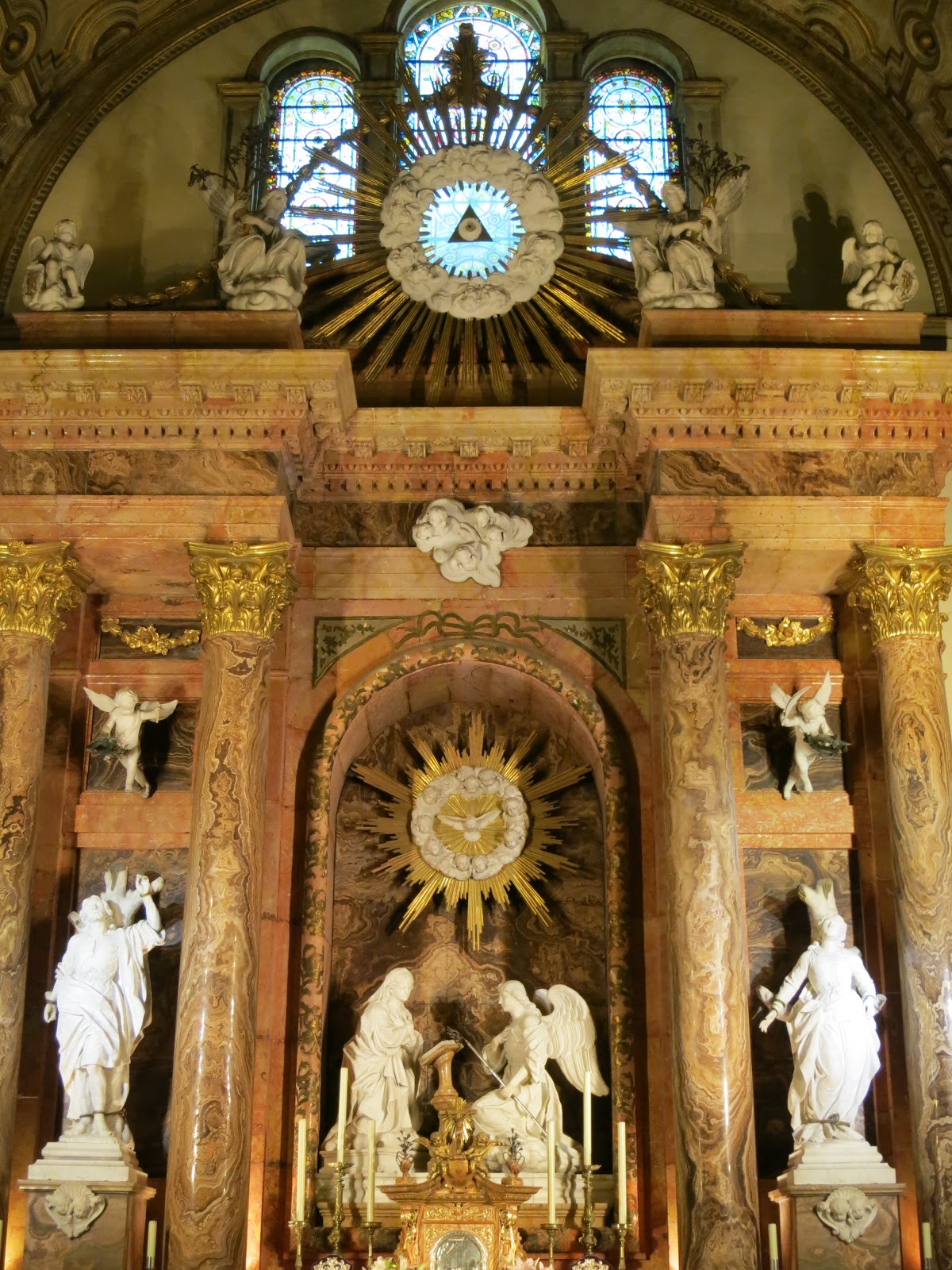 |
| Málaga Cathedral, Spain |
 |
| Málaga Cathedral, Spain |
 |
| York Minster, England |
 |
| York Minster |
 |
| Michelangelo's Pietá, St. Peter's Basilica, Rome |
The church now found it necessary to maintain both its political viability and its unquestioned authority on all religious doctrine. This is one reason that so much of the art of the period was relegated to strictly religious themes--another being that the church was one of the very few institutions that could afford to pay for such art. The artists of the period could only reach greatness if they bent to the will of the church--accepting its commissions as well as its restrictions. The frescos, pietás, madonnas, sculpted cherubim, paintings, reliquaries, the gilded tombs of martyred saints, the towering domes--these were the great masterpieces that adorned the holy places. And the epic scope and awe-inspiring beauty of such works illustrates an attempt to simultaneously become closer to God, and to separate Him from the mundane, everyday life of the populace. After all, how could the church maintain it's unquestioned authority if an individual believed God was attainable through ordinary means, through simplicity, even through poverty?
 |
| Notre Dame de la Garde, Marseille |
Whenever I encounter one of these places, I experience a curious mix of emotions--awe, inspiration, humility, as well as an uncomfortable awareness of the irony of having so much opulence openly displayed within a church whose founding principles included the righteousness of poverty. I try to imagine Jesus preaching to the faithful from the pulpit of these places, and the idea seems preposterous to me.
 |
| Sevilla Cathedral, Spain |
 |
| Choir and ceiling of the Málaga Cathedral, Spain |
 |
| Ceiling of the Baptistery, Florence |
But, whether one sees European churches as ironic and unseemly displays of vast and unjustly-earned wealth, or as holy places of unequaled beauty--or, as is my case, something in between--it cannot be disputed that these place demonstrate with awesome clarity the power of humanity's faith, intellect and spirit.
~Sean
Tuesday, December 18, 2012
German Hospitality
When I was in high school, my family hosted an exchange student from Germany. Her name was Claudia, and we spent a lot of time together during the four months she lived with us. Thanks to Facebook, we have stayed in touch, and I was even able to visit her and her family in Germany when I studied in France.
When we began planning our trip, I contacted her and asked if we might possibly impose on her family for Christmas. We've been very fortunate thus far to have been welcomed into the homes of numerous friends as well as strangers across Europe, but finding someone whom we could visit during a time that's usually reseved for family was especially tricky.
Claudia and her mom, Inge, welcomed us with open arms at the train station when we arrived. Since then, we have been made to feel like both honored guests and part of the family at the same time. We have been enjoying delicious home-cooked meals as well as guided tours around Hessen, the German state where they live.
On Saturday -our first full day here- Claudia and her dad, Martin, took us to visit the town of Speyer which is about an hour away by car. On the way, we stopped at one of Martin's favorite tasting rooms and sampled some of Germany's well known Reisling wines.


The area around Frankfurt and to the south is loaded with vineyards. Most grow white wine grapes, but some grow red. After a few quick tastes, we got back in the car and continued towards Speyer. In order to get there, we had to drive through a handful of small, picturesque German towns and a bit of wine country. I was charmed by the colorful houses and peaceful country-side.

Claudia mentioned that they received a good amount of snow last week, and lamented that we had missed it (they're predicting above freezing temps here through Christmas), but there was still evidence of the storm in the barren woods along the sides of the road. The multitudes of orange-brown leaves still clinging in the trees combined with the bit of leftover snow gave the impression that the forest was trapped between seasons.
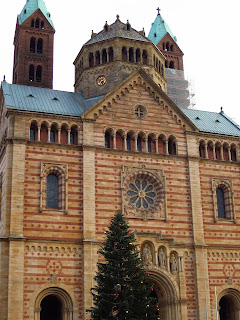
Once in Speyer we began our tour at the cathedral- one of the largest and most significant Romanesque edifices in Germany. It was built by the emperors and designated to be their last resting place as a symbol of their power. The crypt, therefore, is of special interest as it contains the remains of eight German emperors and kings, four queens, and a number of bishops.
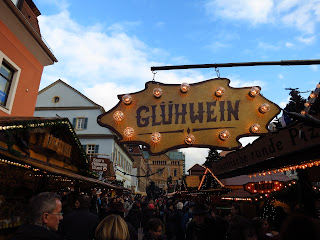
Just outside of the cathedral we found the first of many Christmas markets to visit in the area. We walked down the row of small wooden stands, all decorated to perfection with lights and garland, and each selling a different product specific to the holiday season. Candles, porcelain houses, sweets, trinkets, dishes, chocolate, and any number of other gift-y sorts of things are available for purchase in these quaint, picturesque markets all over Europe, but Germany is especially well known for having the largest, most diverse and most beautiful Christmas markets. On this day, we stopped and enjoyed some mugs of "Glühwein" (hot mulled wine, usually with a bit of sugar and maybe some spices added) being served from one of the many cheery carts offering it. This special drink, which is only available during the cold holiday season, is usually served steaming hot in a porcelain mug which requires a deposit, and which must be given back to the stand it was borrowed from after it's been emptied.
Once we'd had our fill of the Christmas market, Martin lead us up the street to a restaurant where we enjoyed a lovely lunch. Sean- the braver eater of the two of us- went for a traditional German dish of saumagen, bratwurst and sauerkraut, while I stuck with the more familiar, but delicious looking salad with chicken breast. The food here has been fantastic and plentiful and we have been finding ourselves indulging a bit these last few days- not only because it's the holidays, but also because we know we won't be able to get 90% of these (relatively) familiar things for the next 6 months in Africa or Asia.
After lunch we left Speyer and continued on to Heidelberg. This riverside town is the home of the oldest university in Germany (founded in 1386), and also boasts one of it's many beautiful castles. We began by visiting the castle, which sits up on a hill overlooking the town and the river below. The sun was setting when we arrived, and the dimming light made the colorful houses appear even more vibrant as the sunset painted the cloudy sky above a distant horizon.
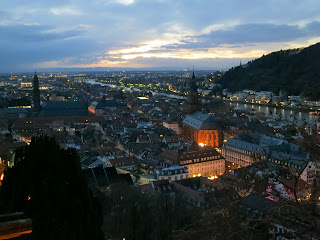
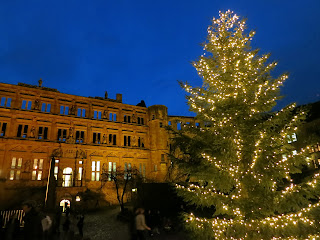
After enjoying the view from the castle's patio, we ducked inside to see what else it had to offer. We found several humongous barrels- all larger than any I had ever seen and each one larger than the one before it- which we were told had been built to hold massive quantities of wine. At one point, we walked up a set of stairs, and onto a deck and found ourselves standing on top of the largest wine barrel in the world; with a 6 meter diameter, it holds a mere 220,000 liters (or 58,000 gallons) of wine. The staircase and deck were built many years ago to encourage partying, drinking, and dancing atop the barrel.


From the castle, we could also see the lights of Christmas market #2 twinkling across a ravine, but decided to pass this one by as we had plans to visit several others in the coming days.

We had planned to do a bit of walking through Heidelberg, but had a terrible time trying to find parking due to the hordes of people flooding the town on a Saturday evening. We opted for a quick drive-by viewing instead, and then headed back. That evening, we went out in Frankfurt with Claudia and a couple of her friends. She took us to a bar that she frequents in Sachsenhausen, an old neighborhood in Frankfurt which is well known for it's trendy-ness and bar-hopping atmosphere. There, we enjoyed games and conversation with the small group, and had fun tasting apple wine (an infamous Frankfurt favorite) and cola-beer (exactly what it sounds like).
On Sunday, we relaxed a bit and booked some flights for the next legs of our trip (coming up: Zambia and Tanzania followed by Malaysia and Indonesia!) and then walked with Claudia and Inge to Christmas market #3 in their little town of Dreieichenhain. This market's booths were scattered throughout the old castle area which stands at the center of the town. Dreieichenhain consists not only of the remains of the old castle, but also a number of houses and shops built in the "Fachwerkhaus" style (a half-timbered style of building where the supporting structure is made of wood and filled with brick, clay, or plaster and the beams left exposed).
We wandered through the market and the castle, sipping glühwein and eating as much delicious German food as we possibly could (our hosts insisted we must have at least a little more room to try just about every kind of food we came across). We half joked that they were trying to 'fatten us up' before we go to Africa, but the way the week is panning out, I wont be the least bit surprised if that ends up being true. Before we left, we met up with Inge's friend Stephanie who has one of the sweetest dogs I've ever met- Molly. Though the booths seemed never-ending to us--especially the ones serving food we just had to try (I mean, seriously? There's MORE?!)-- they insisted that this was a small market, and "Just wait till you see the one in Frankfurt!"


On Monday Claudia accompanied us on the train into Frankfurt where we were able to submit some visa applications at the Thai consulate. After that, we followed the directions she had given us to, that's right, Christmas market #4, and sure enough, it was bigger. Not only did we not see the whole thing, I don't think we could visit every booth there even if we were inclined to spend three days trying. We walked around for a while and picked up a few small souvenirs and tchotchskes, enjoyed a nice bratwurst for lunch, and resisted the glühwein. Then we caught the train back towards Dreieich and enjoyed a quiet evening at "home."


When we began planning our trip, I contacted her and asked if we might possibly impose on her family for Christmas. We've been very fortunate thus far to have been welcomed into the homes of numerous friends as well as strangers across Europe, but finding someone whom we could visit during a time that's usually reseved for family was especially tricky.
Claudia and her mom, Inge, welcomed us with open arms at the train station when we arrived. Since then, we have been made to feel like both honored guests and part of the family at the same time. We have been enjoying delicious home-cooked meals as well as guided tours around Hessen, the German state where they live.
On Saturday -our first full day here- Claudia and her dad, Martin, took us to visit the town of Speyer which is about an hour away by car. On the way, we stopped at one of Martin's favorite tasting rooms and sampled some of Germany's well known Reisling wines.


The area around Frankfurt and to the south is loaded with vineyards. Most grow white wine grapes, but some grow red. After a few quick tastes, we got back in the car and continued towards Speyer. In order to get there, we had to drive through a handful of small, picturesque German towns and a bit of wine country. I was charmed by the colorful houses and peaceful country-side.

Claudia mentioned that they received a good amount of snow last week, and lamented that we had missed it (they're predicting above freezing temps here through Christmas), but there was still evidence of the storm in the barren woods along the sides of the road. The multitudes of orange-brown leaves still clinging in the trees combined with the bit of leftover snow gave the impression that the forest was trapped between seasons.
Once in Speyer we began our tour at the cathedral- one of the largest and most significant Romanesque edifices in Germany. It was built by the emperors and designated to be their last resting place as a symbol of their power. The crypt, therefore, is of special interest as it contains the remains of eight German emperors and kings, four queens, and a number of bishops.

Just outside of the cathedral we found the first of many Christmas markets to visit in the area. We walked down the row of small wooden stands, all decorated to perfection with lights and garland, and each selling a different product specific to the holiday season. Candles, porcelain houses, sweets, trinkets, dishes, chocolate, and any number of other gift-y sorts of things are available for purchase in these quaint, picturesque markets all over Europe, but Germany is especially well known for having the largest, most diverse and most beautiful Christmas markets. On this day, we stopped and enjoyed some mugs of "Glühwein" (hot mulled wine, usually with a bit of sugar and maybe some spices added) being served from one of the many cheery carts offering it. This special drink, which is only available during the cold holiday season, is usually served steaming hot in a porcelain mug which requires a deposit, and which must be given back to the stand it was borrowed from after it's been emptied.

Once we'd had our fill of the Christmas market, Martin lead us up the street to a restaurant where we enjoyed a lovely lunch. Sean- the braver eater of the two of us- went for a traditional German dish of saumagen, bratwurst and sauerkraut, while I stuck with the more familiar, but delicious looking salad with chicken breast. The food here has been fantastic and plentiful and we have been finding ourselves indulging a bit these last few days- not only because it's the holidays, but also because we know we won't be able to get 90% of these (relatively) familiar things for the next 6 months in Africa or Asia.
After lunch we left Speyer and continued on to Heidelberg. This riverside town is the home of the oldest university in Germany (founded in 1386), and also boasts one of it's many beautiful castles. We began by visiting the castle, which sits up on a hill overlooking the town and the river below. The sun was setting when we arrived, and the dimming light made the colorful houses appear even more vibrant as the sunset painted the cloudy sky above a distant horizon.


After enjoying the view from the castle's patio, we ducked inside to see what else it had to offer. We found several humongous barrels- all larger than any I had ever seen and each one larger than the one before it- which we were told had been built to hold massive quantities of wine. At one point, we walked up a set of stairs, and onto a deck and found ourselves standing on top of the largest wine barrel in the world; with a 6 meter diameter, it holds a mere 220,000 liters (or 58,000 gallons) of wine. The staircase and deck were built many years ago to encourage partying, drinking, and dancing atop the barrel.


From the castle, we could also see the lights of Christmas market #2 twinkling across a ravine, but decided to pass this one by as we had plans to visit several others in the coming days.

On Sunday, we relaxed a bit and booked some flights for the next legs of our trip (coming up: Zambia and Tanzania followed by Malaysia and Indonesia!) and then walked with Claudia and Inge to Christmas market #3 in their little town of Dreieichenhain. This market's booths were scattered throughout the old castle area which stands at the center of the town. Dreieichenhain consists not only of the remains of the old castle, but also a number of houses and shops built in the "Fachwerkhaus" style (a half-timbered style of building where the supporting structure is made of wood and filled with brick, clay, or plaster and the beams left exposed).
 |
| Inge explaining to us about "Fachwerkhaus" with some examples in the background |
We wandered through the market and the castle, sipping glühwein and eating as much delicious German food as we possibly could (our hosts insisted we must have at least a little more room to try just about every kind of food we came across). We half joked that they were trying to 'fatten us up' before we go to Africa, but the way the week is panning out, I wont be the least bit surprised if that ends up being true. Before we left, we met up with Inge's friend Stephanie who has one of the sweetest dogs I've ever met- Molly. Though the booths seemed never-ending to us--especially the ones serving food we just had to try (I mean, seriously? There's MORE?!)-- they insisted that this was a small market, and "Just wait till you see the one in Frankfurt!"


On Monday Claudia accompanied us on the train into Frankfurt where we were able to submit some visa applications at the Thai consulate. After that, we followed the directions she had given us to, that's right, Christmas market #4, and sure enough, it was bigger. Not only did we not see the whole thing, I don't think we could visit every booth there even if we were inclined to spend three days trying. We walked around for a while and picked up a few small souvenirs and tchotchskes, enjoyed a nice bratwurst for lunch, and resisted the glühwein. Then we caught the train back towards Dreieich and enjoyed a quiet evening at "home."


Subscribe to:
Comments (Atom)